Let us begin by first talking about faith. When I say the word faith, I would expect you would understand that as your belief in God and that is a valid understanding of faith. But, another word for faith is trust. Faith is what you put your trust in. When we are talking about religion, we are talking about faith in a God or gods. Aetheists are people who do not believe in God, but they still put their trust in something. For many, they put their faith in science, so science becomes their god.
The word religion means relationship. What makes the various religions of this world different from one another is their relationship with God. For example, Christians call God Father for he has revealed himself to be our Father in heaven. This is highly offensive to the Muslims because to them God is supreme and would not lower himself to call his creation his children. We have vastly different relationships with God. So, if we want to begin to understand the Catholic religion, that is the Catholic relationship with God, we have to begin by understanding how God has revealed himself to us.
The problem here is that we are trying to define an infinite God using very finite terms. In other words, we are trying to define the limitless by very limited means. It would be easier to pour all the waters in the ocean into a thimble than for us to fully define who God is. A creed is a statement of faith. Every Sunday we say our creed at Mass. Our creed says this about who God is –
I believe in one God, the Father almighty, maker of heaven and earth, of all things visible and invisible.That is a lot. Let’s break it down so we can better understand it.I believe in one Lord, Jesus Christ, the only begotten Son of God, born of the Father before all ages. God from God, Light from Light, true God from True God. Begotten, not made, consubstantial with the Father. Through him all things were made.
I believe in the Holy Spirit, the Lord, the giver of life, who proceeds from the Father and the Son, and with the Father and Son is adored and glorified.
I believe in one God. We do not have three individual Gods, but just one God who reveals himself to us in three unique persons. This is a triune God, three in one. We are human beings. It is said that God is being itself. More accurately, God is greater than reality. He has no beginning and no end. He exists outside of time and space. All of reality, all of time, from the very first moment until the very last moment, exists inside of God all at once. For God, every place, all of the vastness of space, heaven, hell, earth, and everything in between is here, every moment is now. There is no past, present, or future for God. There is just now and now is every moment all at once.
This one God manifests himself to us in three distinct persons. The first person of God is God the Father. As our creed says, through the Father all things were made, visible and invisible. We are natural creatures and live in the natural, or visible world. There is also the supernatural world which is invisible to us. The supernatural world is where spiritual beings like angels and demons dwell. It is also where all people who have passed from this world to the next are. The natural and supernatural worlds exist together but the supernatural is veiled to our eyes.
The second person of God is known as the Logos or the Word of God. In the fullness of time the Word humbled himself and became incarnate, meaning he took on flesh, becoming one of us in the person of Jesus of Nazareth. He came to reconcile us to the Father, repairing the damage that was done by the disobedience of our first parents, Adam and Eve, in the Garden of Eden. He brought salvation and redemption to mankind. As our creed says, he was God from God, light from light, true God from true God, consubstantial with the Father. Consubstantial is a word that means of the same substance. Jesus and the Father are of the same stuff. The Father wasn’t one God and Jesus another. They were the same God.
Jesus was fully human and fully divine. He had a human nature and he had a divine nature and the two were never in conflict with one another. This is a challenge for people to understand. How can Jesus be 100% one thing and 100% another thing at the same time? No one can be 200%. Here is a visual that might help you to better understand how this works.
On the left side of the room we have a red light. When the light is on it fills 100% the room with red light. Everything in the room looks red. This represents Jesus’ human nature. On the right side of the room we have a blue light. When that light is on it fills 100% of the room with blue light. Everything in the room looks blue. This represents Jesus’ divine nature. When we turn both lights on the room is filled 100% with the red light and 100% with the blue light. The two do not compete with each other. Everything in the room looks purple. Now, if we take a box and place it in the center of the room, when we look at the left side of the box the box will be red. When we look at the right side of the box the box will be blue. When we look directly at the box the box will be purple.
We can see Jesus’ dual natures represented like this when we read scripture. Sometimes we see Christ’s human nature when he is doing something like weeping for his deceased friend or when he becomes angry in the temple. Sometimes we see his divine nature when he does things like forgive sins, heal the sick, or raise the dead. Most of the time we will see Christ’s combined natures working together.
The third person of God is the Pneuma, which is Greek for breath or wind. We refer to him as the Holy Spirit. The Holy Spirit is the Holy Breath of God. In the creed we say that we believe in the Holy Spirit, the Lord, the giver of life, who proceeds from the Father and the Son and with the Father and the Son is adored and glorified. In the beginning God, the Father, used his Holy Breath to proclaim one Word. That Word was Jesus and through that Word came forth all creation. All things were created through him. All things were created for him. He is before all things and through him all things are held together.
Father, Son, and Holy Spirit. This is what we call the Trinity. One God, three persons.
What is our relationship with God?
The English language is usually a vocabulary rich language, meaning we have many words for the same thing. Take for instance the word walk. To walk means to travel on foot between two points. Instead of saying walk I could say amble, stroll, lumber, sashay, trudge, stride, wander, trek, tread, or storm. Each of these words means to walk but in a particular manner. When we use them, you understand exactly how I am walking.
When it comes to the most important word in any language, English is sorely lacking. The most important word in any language is love. In English love means a whole variety of things. I love my wife. I love hockey. I love my pet squirrel. I love pizza. Love has been used in so many ways that it has almost become meaningless.
In Greek, which the New Testament of the bible was written in, they have many different words for love. We have eros, from which we get words like erotic. Eros is the love of passion, lust, and pleasure. We have storge, which is a protective love, like the love between parent and child, or patriotism, love for one’s country. We have ludus, which is a playful love. It is the affection between young lovers. We have mania, which is obsessive love. We have philia or brotherly love or friendship. From this we get words like Philadelphia, the city of brotherly love. All of these types of love are earthly loves. They are types of love we share with one another. There is a greater love than these.
The highest form of love is agape. Agape is selfless, sacrificial love. It is unconditional and bigger than ourselves. It offers boundless compassion and infinite empathy for everyone. Saint Paul explains this love in 1 Corinthians in that famous passage we hear at almost every wedding.
Love is patient, love is kind, it is not jealous; love does not brag, it is not arrogant. It does not act disgracefully, it does not seek its own benefit; it is not provoked, does not keep an account of a wrong suffered, it does not rejoice in unrighteousness, but rejoices with the truth; it keeps every confidence, it believes all things, hopes all things, endures all things. Love never fails. Corinthians 13: 4-8If the essence of God could be captured in one word it would be agape. God is perfect sacrificial love. God has knowledge. God has power and authority. God is love. From this love all existence flows.
There are three rules for love that even God with his infinite power and knowledge respects. The first rule of love is that for love to exist there has to be a giver and a receiver. Sacrificial love could not exist if there was nothing to sacrifice for. If God had to depend on his creation to receive his love, he would cease to be God, for there would be something greater then himself. This is one of the reasons we have a Trinity. The Father, Son, and Holy Spirit share an infinite, sacrificial, agape love between themselves. God needs nothing from his creation.
The second rule of love is that love has to be freely given. Love cannot be forced. There is a particular term for forced love and it comes with a prison sentence. God cannot force anyone to love him or anyone else. Love is a gift freely offered. It is not always accepted or returned.
The third rule for love is that for love to exist there has to be a choice. If there is no choice but love then love is being forced. This is why the tree of knowledge was put in the Garden of Eden. This is one of the reasons there is suffering in this world. Suffering exists so that love can exist.
One attribute of love is that love longs to grow. The Trinity is perfect on its own, but because God is love he longs to increase that love. Love is increased when it is shared. God created reality so that he may share his love with it. God’s love is infinite. It knows no beginning and no end. We were created by Love, for Love, through Love, to be loved, and to love. Let me clarify this a bit. We were created by Love, God the Father, for Love, God the Son, through Love, God the Holy Spirit, to be loved by the Father, Son, and Holy Spirit, and to love, God first and each other as God has loved us. This is the meaning of life.
Because God is all good and bestows on to us every good gift, including the breath in our lungs, we owe God our love, our adoration, and our worship. Observant Jews pray three times a day, morning, noon, and evening. It is what the Catholic Church based her Liturgy of the Hours on. The LOTH is the official prayer of the Church. It is broken up into seven periods – the Office of Readings, Morning, Daytime (broken up into Midmorning, Midday, and Midafternoon), Evening, and Night. All clergy are required to pray these hours. Deacons are only required to pray Morning and Evening hours. Priests and Bishops have to pray five. Many of the religious orders, the monks and nuns, they will pray all seven.
The Shema is the centerpiece of Jewish prayer. It begins with a verse from the sixth chapter of Deuteronomy. It goes –
Hear O’ Israel, the Lord is our God. The Lord is one. You shall love the Lord your God with all of your heart and with all of your soul and with all of your strength.This verse applies to us just as much as it applies to the Jews. We are to love God above all other things. He is to be first in our lives. This is what we owe God for his unlimited love for us. We love God before all else. He comes before our spouses, our children, even our own lives. This is what it means to be in right relationship with God.
God is a Trinity. The Trinity is the perfect family. God wishes to adopt us into his family so that we can live with him forever in heaven. The choice is ours. He has shown us the way but it is up to us to follow that way. He has given us the Church to teach us this way.
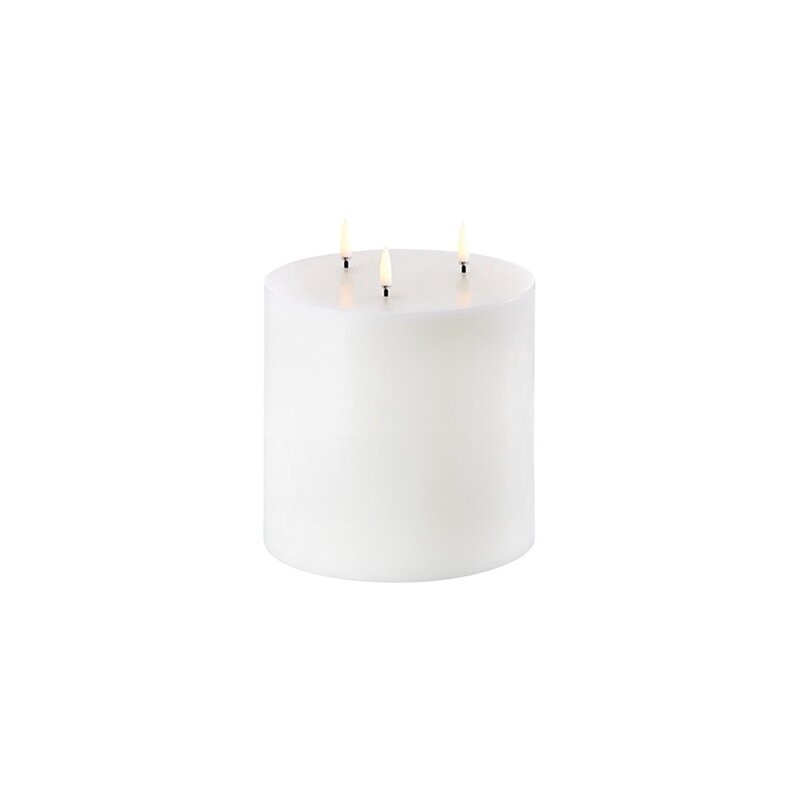
One way we can visualize the Trinity is to look at a three-wicked candle. There is only one candle, but three individual and distinct flames. Each flame draws its life from the same wax. Each flame produces its own light and the flames never compete against one another. The wax they melt combines into one pool, indistinguishable from the other.
One candle - One God
Three flames - Three Persons of God, Father, Son, and Holy Spirit
The pools of melted wax - Three individual wills, separate but indistinguishable from one another.